Labels

Showing posts with label reflections. Show all posts

Sunday, 31 March 2013

Big questions #1: Heart half full or half empty?

When you grow up evangelical, you grow up believing that that is what Christianity is. I guess because we don't tend to label ourselves particularly, except possibly with words like "Bible-believing Christians" (as opposed to all those other Christians who think Jesus spoke a load of rubbish but follow him anyway...) I think as evangelicals, and particularly those on the 'conservative' side, we don't tend to be very self critical and we tend to think we're doing Christianity properly, more seriously than others - that is, if we think they're really Christians at all! All of that has troubled me in recent months and I was pleased to stumble across a definition from Ridley Hall, Cambridge, of their ethos of 'open evangelicalism' - you can read the page here but one bit that stood out for me was this:
Open to God's work in other Christian traditions. Evangelicals do not have a monopoly on the truth, and through partnership and dialogue we seek to be open to learn from what God has done and is doing in other parts of his Church. This refers to other Christians in our own Western setting, but must also increasingly include the voices of our fellow believers in the Two-Thirds World.
 So, I've been trying to pay attention to what we can learn from other Christian traditions, what aspects of evangelical culture or even theology might be rightfully challenged by others, where we might be missing out, and where we can simply learn from the differences. Naturally, I'm gaining more questions than answers at the moment... But I quite like the uncertainty! I'd love to hear what others think about some of these though, both from those who consider themselves evangelical (however you want to define that!) or of another sort of Christian tradition, or not Christian at all.

Here's my first big question - how optimistic a view can we take on the human condition? And what impact does that optimism or pessimism have on the rest of our theology and experience? Does it affect the way we treat people, think of ourselves, and relate to God?

Fallen humanity...?
None of these are new questions. Augustine and Pelagius (if I remember rightly from first year Patristics essays!) wrestled with similar subjects in the when they argued over the whether people had the ability to choose to do good, or whether we're born with original sin. One of the five points of Calvinism is total depravity, the assertion that we're totally enslaved to sin and totally unable to choose God for ourselves. It can become a bit of caricature about evangelicals, that we're so pessimistic about humanity - we talk about sin in every other sentence, not just as the things we do but as the orientation of our hearts, we point out that there's no difference between a fascist dictator and a selfless saint when it comes to our own righteousness before God left to our own devices.

This is what I've grown up with and I think it can have varying effects - on the one hand, it can lead to a deep personal humility, a determination not to judge others because we're all in the same boat, a real appreciation of and dependence on the grace of God, and a security in knowing we're loved and saved not conditionally on anything we do, but unconditionally and eternally. On the other hand, I find myself wondering if those with this view of humanity are often missing a lot - it's a view that doesn't chime well with most people (though obviously popularity is not the same as truth!) because we see good in others and even in ourselves. We want to celebrate achievement and selflessness and love where we see it. It's a view of humanity that can stifle much of our self-expression, our creativity and artistic expression and our spontaneity and initiative because we think that at heart, our humanity is corrupt and bad, so expressing it freely is dangerous. Unconditional love and acceptance despite ourselves might make us more grateful and humble, even more secure, but might it also significantly damage our sense of worth and value for who we are?

There are some more optimistic views of humanity that say we're actually fine, we don't really do wrong, we just make mistakes and grow through them, it's all part of a process for which we don't really need to take responsibility as long as we're well meaning at heart. This is the kind of view evangelicals react strongly against, because it denies the reality of our sin and so downplays the importance of Christ's death for us - it seems the whole Christian message falls apart with this kind understanding of our humanity. But I wonder if we can be optimistic without denying our need for grace? The Iona community seem to capture something of this in their liturgy (© The Iona Community, from the Iona Abbey Worship Book, published by Wild Goose Publications) :
 "We affirm God's goodness at the heart of humanity, planted more deeply than all that is wrong."
...Or good at heart?
The Iona ethos is not about denying our brokenness and sinfulness, those words in the worship book come right after a confession and prayer for God's forgiveness and help. But it affirms that the corruption of our human nature is not the deepest thing in us, that being made in the image of God is even more a part of us that our tendency to sin. I guess the effects of that can be all those things that a pessimistic view denies - an encouragement towards creativity, the valuing of individuals and of our contribution to the world. It might allow us to respond to absolutely anyone, whoever they are and whatever they believe, with welcome and acceptance rather than any kind of suspicion. But what are the dangers? Perhaps we find ourselves getting complacent, or feeling responsible for contributing to our own salvation. Perhaps it raises many more questions about who might be saved, or what that even means. There's risk in moving away from something which starts with everyone evil and condemned before they express faith in Jesus - might we start seeing God's grace in the lives of those who don't acknowledge it? There might be knock on effects for the rest of our theology. Is that a 'Biblical' way to understand God's grace at work?

Any thoughts? How should we understand the inherent corruption of humanity, or the deep image of God and his goodness planted in us? Have I misrepresented any particular view? What other effects might either of those two views have? What are the dangers? Are dangers enough reason to avoid something? Are there other options that I haven't suggested?

Wednesday, 20 March 2013

"...that distinction would always belong to a woman."

I think every family has silly sayings which seem perfectly normal to those on the inside but a bit odd to the rest of the world.  In our family, one of those is "When Dad's queen..." because Dad often has better ideas about how to run the country than those who do, and plans to implement them as queen. As a heads up if you're interested, when Dad does gain the crown children won't go to school till they're 7, and all bananas will be sold with names on them according to how many there are in the bunch, such as Paul, John, George and Ringo on bananas sold in bunches of four. 

I prefer to play "when I'm Archbishop", or in my humbler moments, "when I'm vicar". My latest round of this was inspired by the book I'm reading, which I may or may not have raved  to you about already, "A Year of Biblical Womanhood" by Rachel Held Evans.  She was noting the privileged role given to Mary Magdalene as the first witness to the resurrection, and how she was the one to announce the news to the apostles despite the fact that as a woman, her testimony would have counted for nothing in that context.  She points out that in most churches on Easter Sunday,  a man stands up at front and announces "Christ is risen!" but that if we really wanted to do justice to the biblical story, "that distinction would always belong to a woman".

That got me thinking.  That would be a striking way to commemorate Mary and in fact all the women whose faith played such an important role in Jesus' ministry and in spreading the good news of his resurrection.  In churches where women are rarely stood at the front, let alone preaching the good news, to have a woman speak those history-shaping words on Easter morning would be both an encouragement to the women in those churches that their ministry is noticed and valued, and a challenge to remember that in trusting this task to a woman, Jesus defied all social and religious expectations about what women were worthy or capable of doing. In the new community of those who follow the risen Christ, there are no social hierarchies, no-one above needing to hear the news and no-one beneath preaching it. 

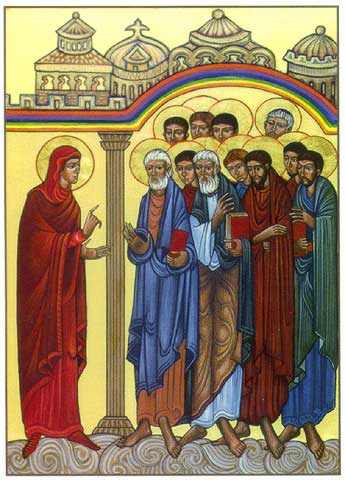
Mary Magdalene,
 apostle to the apostles.
But if I was a vicar, there'd be nothing too striking about a woman standing at the front and announcing that Christ is risen. Fortunately, in a lot of churches no-one would bat an eyelid that it was a woman speaking those words, and that's great - it shows us that those cultural expectations which Jesus began to challenge have continued to be challenged and changed to the extent where it's not so crazy to believe something a woman tells us. 

So if I was  vicar, how would I commemorate Mary Magdelene on Easter Sunday, how would I demonstrate that destruction of social hierarchy and the invitation for all to come and be part of announcing the good news? I think each Easter, I'd ask someone to take that role who is looked down on or disadvantaged by others in society for any kind of reason, because of class or race or sexual orientation or poverty or disability or age or anything else - we're so good at creating hierarchies and telling people they're not good enough, both inside and outside the church, that it shouldn't be a problem to think of many people who could well represent Mary and  take the honour given to her by Jesus. Maybe one year I'd ask the single teenage mum, maybe another year the long term alcoholic. Then the next year I'd ask the child of asylum seekers, and then the next year the great-grandmother with Alzheimers. Another year the trans* woman, and the next year the guy who just came out of prison. 

I'd be worried that to ask those people to make the Easter announcement might be insulting or patronising, as if trying to label them as people as the bottom of social hierarchies. But in reality, it's not about creating "us and them" groups but about recognising that none of the many reasons we look down on others and think ourselves above them makes any difference in this post-Easter community. It's about knowing how much we all need to hear the great news that Jesus is alive, and that we're all invited to be part of passing it on. It's about celebrating that news as a whole community, knowing that its not only for the privileged, the wealthy, educated, married, white, Western European men, but for the Mary Magdelenes too. It's for all of us. 

Monday, 18 March 2013

Nostalgic for the tough times

Nostalgia is meant to be about warm fuzzy feelings.

Memories of harmonious family days out, or streets safe enough to play on, or TV with only four channels to choose from and everyone settling down to Blind Date. It's meant to be about home cooked Sunday roasts and board games and laughing till it hurts. Or at least, that's what I feel like nostalgia should be.

So it was strange to notice, as I walked home on a cool, sunny evening last week, that I felt strangely nostalgic as I listened to old songs on my iPod that reminded me of difficult times and difficult feelings from when I was a teenager. They took me straight back to walking my paper round route, at a similar time each evening when I was 13, 14, 15.

As I walked, there was always something on my mind. It was my time to process whatever was going on at home and at school, in my friendships, in my relationships. I used to hardly notice the houses I was delivering papers to or the roads I was crossing, because I was playing over old conversations in my head, playing out future scenes as I thought they might go, wrestling with questions and coming to few conclusions. Some of the things I thought about were situations beyond my control - they were family problems, things that happened to me and around me, without my permission and without my input. I wanted to think through how best to react, and how to do good in a bad situation. I tried to figure out which of my feelings about it all were justified, which were helpful feelings and which I should bury completely. I spent a lot of time feeling trapped, feeling powerless.

Some other situations that I used to think about were brought upon myself. I made mistakes as I tried to work out how relationships worked, I struggled to understand myself or other people a lot of the time. Sometimes I hurt people by accident, sometimes I felt like I knew what I was doing and did it anyway, which confused me all the more. I hated that I did things I didn't want to do, I hated how little control I seemed to have over the parts of my life I should be able to control. I used to talk things through with my youth worker sometimes, and we'd have the same conversation over and over. I'd make decisions and go back on them in a day, I'd have new start after new start, determined to get things right this time. It was exhausting and apparently fruitless.

And somewhere in amongst it all, there was a faith growing in me. I've given my testimony a few times now, and tried to work out each time which were the significant points where God showed me I needed him, or that I could trust him, or he did things and used people to bring me a step closer to him - and there were those significant points, plenty of them. But actually, I think a lot of the time in those years, faith was growing in the background, quietly. Or not so quietly. As much as through the people who spoke to me and the sermons I heard, faith grew through the songs I listened to on my old Walkman, from Dad's old worship CDs and from bands I'd heard at Greenbelt and Spring Harvest. It was the words of other people, singing about the God they knew in difficult times as well as good ones, which helped me to connect up the crap going on at home and in my relationships with the message I knew about a God who loved me, and sent his Son so I could know him. They gave me words to articulate that crap, not just as load of stuff to deal with, but as stuff that God could use to help me depend on him. They gave me words to start understanding the habits I couldn't shake and the parts of me I didn't like as things that God could transform, to see in myself potential rather than hopelessness.

A South African band I saw at Greenbelt called Tree63 had a song that seemed to sum up my frustrations at my own behaviour. Overdue went like this:

Struck by lightning once
You conceived a flame
Now every waking second
I'm waiting for the blaze
But is it ever going to come?
What am I supposed to do
When everything I could become is overdue?
Out of frustration
Comes a patient man
I'm on the verge of something
End of what you began
But is it ever going to come?
What am I supposed to do
When everything I could become is overdue?

It told me my experiences of frustration with myself even after those significant moments with God, weren't unique to me and didn't mean I couldn't be a Christian. They didn't make me a failure in God's eyes. But it encouraged me to keep up the struggle. The final words of that song went: Just the smallest spark, it set my world on fire. I see you in my dreams. In hearing other people voice my frustrations, I learnt that I had potential to be all that God made me to be, and that was worth struggling for. 

There was another sort of song too which challenged me a lot as a teenager. It was the sort that told me no matter what my circumstances, God was still God, still reliable, still faithful, still in control, and still worth living my whole life for, whatever the cost. Another Tree63 song, I Stand for You (hear it on YouTube) taught me that. I remember listening to it through tears and with gritted teeth as I sat on a park swing struggling with the implications of being a Christian. I thought about the need to commit to unconditional forgiveness, and experienced the cost of that where I was being hurt again and again. I thought about the rejection following Jesus might bring, and felt the sting of it. But I got to the line that said "Guilty of disgrace, but you took my place. So Jesus, I'll always stand for you", and was convinced it was worth it.  

Perhaps the songs that most grew my faith in the difficult places though were the ones that spoke of God being right in there with me, of his nearness in suffering as well as in in joy. There was an old Matt Redman song from the 90s called The Friendship and the Fear, and it spoke of God as one who whispers in our ear as we try to live for him. It said, You confide in those who fear you, share the secrets of your heart. I learnt of a God I could know, really know, and who really knew me. It made all the difference. It didn't stop crap times being crap. It didn't change the situations going on. But occasionally, it gave them profound meaning. Often I forgot to turn to God with difficulty, but the times that I did were special, and they've stuck with me. I have no idea who it was (please take credit if it was you!), but someone  said to me very recently that worshipping God in times of suffering is something we'll only get to do this side of heaven. It doesn't mean that suffering is a good thing, but part of the privilege of being human is that God can profoundly meet us in it, and that changes us. 

So why nostalgic? I'm not entirely sure. It's not that life is perfect now, although so many parts of it are in fact brilliant. Maybe it's that I don't tend to listen to those old songs much any more, and old music has a way of making you feel nostalgic. But more than that, I think there's probably something in the way I handle both the general difficulties of life, and the frustrations that I still have with my own bad decisions and habits, which is different now to when I was 14 or 15. At 22, I feel like I should be self-sufficient. I've worked a few more things out. I've leant therapy-language to work through my emotions. I know how to talk to people about what I feel, I know how to cope with some situations that were overwhelming as a teenager. And I've gained a kind of pride which means those parts of me I used to struggle with and really fight with, because I knew God could transform me in to who I was meant to be, well I don't struggle with them so much any more. The sense of my own potential I used to have has become a sense of pride that I'm fine just as I am, and it means I make excuses for myself. 

There's a line from the rhyming genius that was my 15 year old self, from a poem I called Lilac Walls, which said "I wish I could go back there, though life could be pretty crap there." It's not that I want those same circumstances back. But I'm nostalgic for the dependence on God that I used to know, the knowledge that however hard the circumstance, I needed him all the more. I'm nostalgic for the vulnerability of singing those songs through the pain, with no idea what to do about it except bring it to God. I  miss the Saturday afternoon walks to Wesley Owen to buy a new CD, ready for my whole perspective on God, life and myself to be grown and challenged through a few songs. I'm ready to shake off some of the pride and cynicism, some of the dependence on myself and other people that I've collected over 6 or 7 years, and go back to the struggling with God through suffering when it does come. I don't want to give up on believing I could be more than who I am, that God has big plans, that he wants to change me through every circumstance of life. C.S. Lewis said, "God whispers to us in our pleasures, speaks in our conscience, but shouts in our pains: it is His megaphone to rouse a deaf world." Perhaps its time I learned to pay attention again. 

Monday, 18 February 2013

Cracked heels and broken nails

I've got mixed feelings about my hands and feet. They don't look a lot like this for a start:


My feet - never much of a fan. I mean, I don't have a foot phobia like a couple of friends I could mention, but I've never found anyone's feet very attractive and I don't particularly rate my own. That's probably all the detail I'll go into on that.

My hands - feelings vary.  I quite like my hands for being little, except when it gets me mocked, and I like that a bit of skin is different colour, and that there's still a red dot there from the anaesthetic needle that went in when I was four. But really, how I feel about my hands depends a lot on the state of my nails. If you saw my last post, you'll have seen a picture of my nails when they were doing fairly well. When they're bitten and nasty, I'd rather keep my hands out of sight.


My feelings might change though if I thought of them as Christ's hands and feet.

The idea has been on my mind since our last Core Group meeting for the Church of England Youth Council, in which we were discussing how to incorporate social justice issues into a theme for the next full council meeting in April. The theme that we settled on was "Hands and Feet of Christ", and we wanted to make sure there was time in the day to unpick what that means for us and what it would look like.

As well as being obviously related to Paul's image of the Church as the body of Christ (presumably including hands and feet!), the image is taken from a poem by St Teresa of Avila, written in the 16th century:

Christ has no body but yours,
No hands, no feet on earth but yours,
Yours are the eyes with which he looks
Compassion on this world,
Yours are the feet with which he walks to do good,
Yours are the hands, with which he blesses all the world.
Yours are the hands, yours are the feet,
Yours are the eyes, you are his body.
Christ has no body now but yours,
No hands, no feet on earth but yours,
Yours are the eyes with which he looks
Compassion on this world.
Christ has no body now on earth but yours.


It's one thing to think in general, abstract terms that as the Church we're Christ's ambassadors in the world. I tend to think that means it's my job to look mildly offended on his behalf when someone uses his name irreverently. We're Christ's body, sure. That's a handy metaphor to remind us that we've all got different roles to play. For instance, for a normal Sunday morning, one person makes the Powerpoint of song words, another clicks through it during the songs, and another apologises afterwards for the wrong verses being shown at the wrong time. It's Christian team work. It's easy to think in those terms about being Christ's representatives or his body.

But Teresa's poem catapults the idea uncomfortably close to home. I can see my hands now. I can see my feet. These physical limbs, bits of body that I use constantly, all day every day, these are the pieces of bone and muscle and blood and stuff that Christ has chosen to use to do his work on earth. Fortunately, not only these ones; thank goodness for the rest of the Church. But all the same, he's chosen these ones.

So if Christ were to have exclusive use of my hands, what would he use them for? If he were living my life just as it is, what would he be doing with them? Would he be writing a blog post right now? Or would he be working in the local homeless shelter? Would he be holding the book I'm meant to be reading for tomorrow morning's class? Or would he be texting back the friend I haven't spoken to in so long?

What about my feet? Would he walk as quickly to lectures as I do, swerving in and out of the crowds on Cornmarket to avoid as many charity collectors as possible? Would he be walking towards people or away from people? To friends or strangers? Would he use my feet to be more committed to getting places on time and keeping commitments? Or would he use them to stop, to be interruptible whenever people need time? Would he walk alone around my college lake more often, to get space to really talk with his Father? Or would he invite another wherever he could so as not to waste an opportunity to love and encourage?

That's all just for now... Where on earth would he take them next year? Would he take these feet travelling around the world, using the hands to serve as many people as the feet took him to? Would he reaching out with human touch and comfort to forgotten children across the globe, taking them food and walking alongside them? Or would his steps be a little more contained within a parish, walking from house to house and stopping a while to really spend time with people? Perhaps he'd rather walk the same route each day to an office, using his hands to earn money, so he could give and serve with much more than before.

If you can see obvious answers to those questions, I'd love to hear your thoughts; if the answers are there, I'm missing them at the moment. What strikes me though is the sheer number of opportunities I have to use my hands and feet in the every day to show compassion and to bless. Which particular opportunity I pick at any one time seems to matter less than just picking something and doing it. Many aren't mutually exclusive, and perhaps if I were to start thinking just at one point in a day, "how might Jesus choose to use my hands and my feet in this particular situation, journey, opportunity?" then I might just find myself thinking that way more naturally. Perhaps I'd learn to live a life in which my hands and feet were constantly tools for Christ's work, when I was consciously thinking about it and when I wasn't.  In the mean time, I'll need to start asking that question more consciously. Where would you start? Does it matter what we choose to do with them in any one moment, or just that we do something through which Christ encourages and blesses and serves and loves?

My feet are really nothing special to look at (hence the lack of photo of my own...) and my hands don't look out of the ordinary either. But if I were to allow them to be used in each moment as very ordinary, physical, weak, vulnerable, human hands and feet of Christ, then they'd be something really remarkable. Perhaps then each broken nail, cracked heel and little toe rubbed raw and blistered wouldn't just be embarrassing imperfections on my limbs. They'd be signs that Jesus was getting good use out of them.

Friday, 8 February 2013

A Kingdom kick in the gut.

"That Jesus had some good morals didn't he? Be nice to people and stuff. I generally agree with him and stick to them."

This is a line we evangelicals roll out a lot to try to sum up what we think non-Christians think of Jesus. It's a favourite of ours actually, to tell everyone else what they probably think of Jesus, so that we can tell them why they're wrong. So in this case, we encourage people to say that they think Jesus was a good moral teacher, and then we pounce with the C.S. Lewis "mad-bad-or-God" argument. As Lewis wrote, a good man with good morals is not an option that Jesus has left open to us - someone who taught what he taught, claimed what he claimed, and asked of his followers what Jesus asked, can be no good teacher. Either he was insane, or he was a manipulative (and very successful) conman. Or he was telling the truth, and he is God.

The reason I bring this up though, is not that I've spotted a few non-Christians speaking of Jesus this way, who need it pointed out to them that no nice moral teacher claims to be God. No, it's more that I'm hearing Christians think this way. In fact, I tell a lie, I can't hear anyone think. It's that I've found this thinking in me.

It's not that I don't think Jesus is the Son of God. It's not that I think he was just a man with nice things to say. But that when I think of Jesus' teaching on the way we should live, I most often think that what he taught  was nice, good, about being kind. I think that I generally agree and that for the most part, I do okay at putting them into practice. Perhaps its that evangelicals have such a focus on the radical gospel of grace, the good news that in Jesus, God took our human nature, died and rose again so that we could be freely forgiven, accepted and welcomed by him, that we don't have much time for the radical nature of his teaching on how we should live in the light of that.

This is what I've discovered as I've been reading the next part of the sermon on the mount. Jesus didn't say nice things. He said absolutely crazy things. He said things that make you go "but, are you sure? What about when...?" and that make you want to tell Jesus why he's got that a bit wrong.

The words speak for themselves but I thought I'd briefly leave you my thoughts on two of the radical things that Jesus says should mark out the lives of people who are part of his kingdom. Firstly, radical integrity. He says:
 "Let your 'yes' be 'yes' and your 'no', 'no'; anything beyond this comes from the evil one." (Matthew 5:37)
Now, that might not be radical for you. It's probably not, because you're probably a much better person than me. But I've found integrity is something I've struggled with. When I read this verse I found myself reflecting on why that is, and why having this kind of integrity and trustworthiness might be something fitting for people who are part of the kingdom of God. It's not that I want to be deliberately deceptive, arranging to meet up with people and then letting them down just for the fun of it. It's not that I tell lies to sell to a paper and earn myself money and infamy. Not yet anyway. I think sometimes its that I want to please other people or make myself look good to them, so I say yes to things that I'm really saying "oh no..." to in my head. That leaves me likely to cancel or make excuses. Sometimes its that I'm scared to be honest or ashamed of what could be the truth. I find myself promising that I won't do something again, that I'll be better, that I'll make good decisions and use wise judgement, when in fact I can see my own heart and I know there's a very real possibility that I won't live up to the standards I'm claiming for myself. I'm too scared to admit that actually, I can't guarantee I won't make that same mistake again. So again, it leaves me likely to let people down, and in the end it makes all my earnest promises pretty meaningless. Jesus calls us to integrity, to stick to our word, to say what we mean and follow through on what we say. I'll come to why in a minute...

The second value that Jesus calls us to which winded me slightly was radical generosity. Read Matthew 5:38-42, but I paraphrased it like this:
Firstly, don't respond to the evil of others. Don't inflict pain on others when they have inflicted it on you. Don't resist when someone else hurts you. In fact, when they do hurt you, respond with a continued vulnerability and love towards them. Secondly, do respond to the needs of others. When someone tries to take from you forcefully, or in anger, give them even more that what they demanded. When someone wants you to serve them, serve them twice as much as they asked for. When someone asks you for something, just give it to them. When someone wants to borrow from you, let them. 
Obviously that kills all the vivid imagery and context-appropriate examples Jesus uses, but I wanted to strip it back to the principles general enough to apply to my life too. It's staggering. Don't respond to the evil of others, but do respond to their needs. Not grudgingly or even dutifully but generously.

This challenges every single part of my life. For instance, I get defensive enough when my friends make jokes at my expense, and I want to make sure I'm giving as good as I get. So if anyone is actually unkind to me, the same defensiveness is usually my response. Make sure they get as hurt as me. Make sure I come out on top here. Maintaining my vulnerability and love is not the natural response. [As an aside, these verses raised all kinds of questions for me about abuse, protection, justice, pacifism, and so on. But I didn't want to get bogged down in those because I know myself, I know it's far easier to look at those complicated and sometimes theoretical issues and ignore the glaring need to put this into practice in the every day, simple situations. There's a lot more to say on the complicated stuff though, let me know if you have any initial thoughts.] 

What about lending or even giving to everyone who asks? If you've ever walked around Oxford for more than 20 seconds, you'll know how commonly you get asked for money. There are more people sleeping on the streets in Oxford, selling the Big Issue and asking for money, than I've come across in almost any other city. Can Jesus really expect me to give to everyone who asks? What about the small print, what about the conditions? Shouldn't I check what they're going to spend it on first, shouldn't I tell them not to worry because I've given money to a project instead? Shouldn't I look for the most vulnerable looking person and give my money to them? Or shouldn't I have a quota for the day? These questions are the reason Jesus' words so so striking and so radical. "Give to the one who asks you." It's so simple and cuts right to the heart of my selfish desire to hold on to all that is mine, not to have my life and my stuff intruded upon by anyone who just asks. What if word got out, and everyone started asking? It's like I want Jesus to just be a bit more sensible about generosity.

I started to think of ways I might put this into practice. What if I counted on an average day how many times I'm asked for money? Say it was ten times. What if I went to the bank in the morning and got £5 changed into ten 50p coins? Then I could keep those ten coins in my pocket all day and give one away each time I was asked for money. But then, if the number of people asking went up... well I could just get it changed into smaller denominations. I could give out 20p coins instead. Then I'd still be sticking to what Jesus said, and it's still pretty generous...

Here's the heart of the issue. Maybe that is a good system to use, maybe it's not. That's not really the point. As ever, the heart of the issue is an issue of the heart. My heart. Even in my earnest attempts to put in to practice Jesus' teaching, even then I wouldn't be able to escape my selfishness.That's why it's so radical, so revolutionary. It really does involve a fundamentally different way of looking at the world, looking at my life and my stuff and my money.

I've written far more than I intended, so a final thought. Why does Jesus come up with these revolutionary principles for living, and how can he ever expect me to put them into practice when I'm weak, scared and selfish? The answer to both, at least a partial answer, is the same. This is what God is like. A few verses later Jesus will say "Be perfect therefore, as your heavenly Father is perfect" (Matthew 5:48). It is God who is characterised by radical integrity, total trustworthiness. It's the 'yes' and 'no' of God which we can totally trust, God who has never gone back on a promise. It's God who is generous beyond measure, showing grace instead of giving me what I deserve, continuing to love me when I hurt him. It's God who always gives more than I ask for, who "goes the extra mile" (to use Jesus' language), who never turns me away when I'm in need. He perfectly lived out these things in Jesus who "did not come to be served but to serve, and to give his life as a ransom for many" (Mark 10:45). So as a citizen of God's kingdom and a child of my Father, of course it's fitting that I should live like this too. As I spend time with him, experiencing his trustworthiness and generosity, it's that character which I'll begin to reflect in my life. It's infectious, and God promises to make us more into his likeness as we keep looking to him. I trust that he'll come through on that promise.

So, in a few months time, feel free to ask me how my generosity is going. Ask me whether I'm responding defensively or graciously when I'm hurt. Ask me how tight a grip I've got on my own purse. Hopefully I'll be honest enough to tell you the truth.

Friday, 1 February 2013

Kingdom hunger

It's been good to read back over what I wrote a couple of weeks ago, as this week I've felt particularly like an unsuccessful Christian. Thanks for the messages letting me know I'm not alone in that, they've been really appreciated!

I won't write a post on each of the beatitudes, though all of them have made me think, and some have puzzled me more than others. But this one in particular got me thinking:

"Blessed are those who hunger and thirst for righteousness, for they will be filled."  (Matthew 5:6)

It's sometimes said that Matthew and Paul have different concepts of 'righteousness', but the more I think about it, the more I think it's impossible to have one without the other. Paul's concept of righteousness is a status before God. In Romans, he says that on our own, "There is no-one righteous, not even one" (Romans 3:10) but that through Christ, "the righteousness from God has been made known" (Romans 3:21) and "this  righteousness is given through faith in Jesus Christ to all who believe" (Romans 3:22). For Paul, righteousness is about being put in right relationship with God, not by our own innate goodness or effort but by faith in Christ.

As for Matthew, his concept of righteousness is said to be an ethical one. Having talked about the obedience to the commandments, Matthew reports Jesus as saying, "For I tell you that unless your righteousness surpasses that of the Pharisees and the teachers of the law, you will certainly not enter the kingdom of heaven." (Matthew 5:20)  If righteousness for Paul is about being put into right relationship with God, for Matthew it's living a life that shows it. A righteous life is one that is fitting for someone who knows God, reflecting his character in the way they act graciously and generously towards others. There's another element to this too. Matthew is known for his use of the Old Testament (however clumsily he might do it sometimes!) and making use of Hebrew words and references. In the Old Testament, the word righteousness is often part of a phrase, "justice and righteousness". Over and over again, they're concepts that come together. I can't say much about the significance of that in the Old Testament, especially because Rosie has written a whole dissertation on the subject (so direct all questions her way...) but it does seem like Matthew would have that in mind as he talks about hungering and thirsting for righteousness. It's not just about my little world, my little bubble. There's something bigger going on. There's injustice in the world, and God's work is bringing about justice. There's oppression in the world, and God's work is bringing about freedom. My own little life can't really be righteous, a right response to God's grace, if I'm not joining in with his work.
Micah 6:8 comes to mind:
He has shown you, O mortal, what is good.    And what does the Lord require of you?To act justly and to love mercy    and to walk humbly with your God.
So what is righteousness? It's being in right relationship with God, by his grace, and living out right relationship with God, joining in his work of putting the world right again. It looks like acting justly, loving mercy, and walking humbly with God.

Does that make you hungry? Anyone who has lived with me will know what I look like when I'm hungry. It usually involves pacing around the room, melodramatic announcements that I'll have faded away within minutes if I'm not fed, and a very keen interest in everyone else's food. It's a moment of desperation and focus on  the goal. Thirst on the other hand is not something I notice much in this country, but when I was in Israel a couple of summers back, I knew real thirst for the first time. When we'd walked the Jericho road from Jerusalem, or scaled Mount Sinai, or even just been looking round some archaeological site in blistering heat, there were few things we wouldn't have done for cold water.
There was a real dilemma on the Jericho road when we passed a stream which was almost certainly part animal pee, but someone had chlorine tablets so it was tempting. The point is, hunger and thirst even in my very limited experience of them, look a bit like desperation. What if that was how I felt about righteousness? What if that was my focus, my passion, my obsession even? What if that's what kept me up at night and had me pacing round the kitchen? What if, even more than pancakes and pies and Pimms, I craved life in right relationship with God, joining in his work of making the world right again? It sounds a little like hard work, and a little too optimistic for my liking, if I'm honest. As if me chasing righteousness would make any difference to anything...

But. They will be filled. How come? There are two ways to look at it. On the one hand, joining in God's work is fulfulling in itself. This is what we're created for, to participate in the life of God. Seeing his kingdom coming on earth, bit by bit, in our lives, in our communities, is the most fulfilling work we could ever do. We get glimpses of it, I think, in day to day life: when we show grace to someone and see the effect that has on their day, when we do something generous, when we make a good decision rather than an easy one... We get that satisfied feeling, perhaps unexpectedly, just for a moment. When I know I have to serve in some way and I'm feeling grumpy about it, or when I feel I should do something just or generous but I don't want to, it's at those times that God takes me by surprise with how satisfying it is to live rightly, and I'm humbled.

The second reason that those who hunger and thirst for righteousness will be filled, is that this is the direction of God's work - so we can be sure it'll be completed. He's promised that the earth will be renewed, creation will be redeemed, there will be an end to injustice and oppression, and there will be an end to the sin in my own heart that stops me living rightly. Justice will roll on like a river, and righteousness like a never failing stream. (Amos 5:24) So those who are are already hungry for it, looking out for it, desperate for it, they'll be the ones who are satisfied in the end.

Blessed are those who hunger and thirst for righteousness, for they will be filled. What are you aching for?

Sunday, 20 January 2013

Kingdom success

Since I started my resolution to read through the Sermon on the Mount properly and start putting it into practice, I've been moving pretty slowly - it's taken me a week and a half to get through the the first 8 verses. But I thought it was time to write up my first few thoughts all the same. So here they are:

"Now when he saw the crowds..." (Matt 5:1)
Firstly, I wondered why there were crowds. When I walk around, there's not (usually) a crowd following me and hanging on my every word. So why, so early in Jesus' public ministry, had he gathered such a following? Reading back a few verses I saw that Jesus had been doing two things as he travelled through the area - speaking and healing. Those are the two things that made Jesus so captivating that people from all over the place want to follow him. I think the two must be linked - he was speaking about the good news of the kingdom and he was demonstrating it with his actions. Whatever this good news of the kingdom is, it seems to have dramatic implications for life right here on earth, specifically for sickness and disorder. Jesus is so captivating because his message is captivating, and because he practices what he preaches. The crowds don't just hear about this kingdom, they see it.

"Blessed are the poor in spirit..." (Matt 5:3)
Here the theologian in me wanted to start examining the various meanings of makarios, translated here as 'blessed are', but by others as 'happy are', or in my Greek tutor's own translation, 'congratulations to'. Discussing those meanings does shed some light on the ways we might think about the purpose of the beatitudes as a statement of blessing more than a to-do list and so on, but that's the easy part for a theologian. The bit I tend to miss is looking at the content - what does it mean to be poor in spirit or to mourn or be meek? Why is it that these things in particular constitute success and blessedness, according to the values of this kingdom that Jesus keeps talking about? What kind of kingdom values the poor in spirit?

I couldn't straight away imagine what Jesus might have meant by poor in spirit, so I tried to imagine the opposite, rich in spirit. For me, that conjures up images of "successful" Christians. Not necessarily the ones who fake it and only want to make their faith look good from the outside, but those who seem to 'get' Christian life. It makes me think of people who lead worship, and actually mean all of the words they sing most of the time. Those who are happy to stay behind and wash up or put tables away after a Bible study, because they're pleased for an opportunity to serve. Those whose instinct is to turn to God in difficult situations and who share their faith naturally with friends and strangers and who are patient with irritating people because they love them as brothers and sisters. Successful Christians, you know? Obviously, those things are the aim, I don't think Jesus is at all condemning those who are getting on with faith well, who are living out their relationship with God successfully! But perhaps those aren't the people who need reassuring that they're blessed. They're already secure in the knowledge of their acceptance by God through his grace.

Maybe it's the poor in spirit who need to know they're blessed. The poor in spirit, those who find themselves almost weekly fighting grumpiness on the way to Church; who have to grab their friend to pray against their own cynicism when surrounded by chirpy Christians for too long; who struggle with the same struggles for year after year, until they just talk about it less so others think it's 'progress'; who can think of a hundred reasons to excuse themselves from practically serving and only feel slightly guilty about leaving others to do the work; who spend the majority of their prayer times apologising to God for wandering thoughts or falling asleep... (I hope you've got by now that this is a self-description!) Poor in spirit. Those who don't seem to be very good at being Christians, and know it every day.

Jesus says they're blessed, and theirs is the kingdom of heaven. It's not that 'successful' Christians aren't blessed and aren't part of the kingdom. But for the poor in spirit, this is the ultimate reassurance that it doesn't depend on me. If we really believe in the gospel of grace, that the kingdom of heaven is open to all, that Jesus death was enough to bring me back to God, that his resurrection really guarantees life for all who come to him, that his Spirit is a seal marking me out for God's kingdom... then it makes no difference how often I have to try again. The value of achievement and success is so ingrained into our culture (and it's the air we breathe at Oxford) that its so easy to carry that across to Christian life too. Even if we remember that life isn't about being materially successful, that God won't judge us on the size of our business or the growth of our investments, we can all too easily measure our success at Christian life too, and create the same kind of hierarchy. We can get our self esteem from how well we're doing at prayer, evangelism, service and humility. We can think we're less loved, less valuable, less blessed when we're not doing well at those things. But in God's kingdom, take heart - blessed are the poor in spirit.

[[Note: Think I've completely missed the point here? Think Jesus was saying something entirely different? I'd love to hear other thoughts on what it means to be poor in spirit, or what it means to be blessed...]]


Friday, 18 January 2013

Hear the call of the Kingdom...

A couple of weeks ago, I saw something on Twitter which caught my eye, and struck a chord:
                                                                                           
"For people who interpret every part of the Bible literally except for The Sermon On The Mount, we pray.@unvirtuousabbey"

It struck a chord because no matter how much time I spend (and how many essays I write) on working out the best best way to interpret various bits of the Bible, how different stories were originally intended and understood, what 'literal' and 'historical' and 'mythical' even mean - it's still so easy to ignore its call and its challenge. It's easy to study the words of the Bible and not listen to God's Word.  Even when I do remember that I'm meant to be living it out in my every day life, it's still tempting to get wrapped up in the difficulties, the controversy, and claim it's difficult to know exactly how to live without getting Paul to write me a personal epistle about my personal situation.

And then I remembered the Sermon on the Mount.  Never let me say that I don't know what God wants me to do with my life until you're convinced that I'm putting into practice everything in Matthew chapters 5 to 7. Perhaps the most captivating part of the whole Bible, the most revolutionary manifesto, the clearest teaching  we have from Jesus, and yet the most ignored by Christians who claim to take the Bible most seriously. Myself included. 

So I made a resolution (shortly after New Year but I reckon it still counts) to work through the Sermon on the Mount in my time with God each morning, however slowly I need to, asking him to show me what it would look like for me to start living according to these three short chapters. And then I'm going to pray for the grace to do start doing it. There might be a few blog posts about it along the way... 


In the mean time, here's a song (specially the second verse) which captures for me something of the excitement and the possibility of living out what it means to be part of God's kingdom and to want to see it in our every day contexts.

Wednesday, 26 December 2012

Immanuel

God in our mess.
In our carrying on nevertheless.
In our working out plan B.
In our "is this the way it has to be?"
In the sinking of our heart.
In our ideals falling apart.
In our wishing for togetherness.
In our very real brokenness.

God become baby.
Born into circumstances hazy.
Born into territory occupied.
Born into nation's hopes unsatisfied.
Born into complicated family.
Born into baggage and a history.
Born into love and deep affection.
Born into heart-wrenching rejection.

God living our humanity.
Stepping into our calamity.
Joining us in suffering.
Adding his tears to the offering.
Healing us from our distress.
Covering our nakedness.
Sticking around, never to leave us.
Immanuel, our God is with us.

Wednesday, 19 December 2012

There is a judgement to come - Why are we waiting? #4

After the tragic shootings in Newtown last week, there's been much  written in the way of response, not least from Christians. Some have attempted to defend God's justice, others to declare his judgement, many simply expressing grief and honest incomprehension. Nearly a week on, I didn't want to try to add anything, or to critique other people's responses. Plenty has been said. But after my last advent post on trusting Jesus' promise to return, I've been reflecting on why it's a good thing that he will return. I've become convinced that Christ's second coming that we look forward to during advent is not just a wacky doctrine for end-of-the-world fanatics, not just a neat solution to tie up the loose ends of the Jesus story, but a truth that speaks to the heart of our suffering and affirms our indignance.

2012 X Factor judges
The New Testament claims that when Jesus returns, it will be as Saviour and Judge. Jesus claims for himself all of God's authority in heaven and on earth, the authority given by the Ancient of Days to the one like a son of man in Daniel 7. I'd always imagined these two roles as separate, as opposites. The 'saviour' part is obviously a good thing, but 'judge' doesn't always have such positive connotations. Judge makes us think of judgementalism, of intolerance and fault-finding, of superiority and criticism. It could make us think of corrupt judges, taking bribes for protecting the powerful. Or perhaps our minds jump to the X Factor judges, commercially minded and equally comfortable  with dishing out both cruelty and flattery.


But recently I read about a judge who changed all those images for me. Joaquim Barbosa, the first black member of Brazil's supreme court, presided over the massive trial responsible for convicting 25 powerful people for offences around money-laundering, bribery and fraud. Barbosa has become something of a national hero for bringing to justice many corrupt politicians and working to end a culture of manipulation, greed and impunity in Brazil's power structures. By his courage in bringing justice to corrupt leaders, Barbosa represents freedom and truth for Brazil's people.

To a world held in the grip of human selfishness, of greed, of addiction, of oppression, and of sheer cruelty, Jesus' promise of judgement speaks that same freedom to all of us.

That Jesus is coming to judge evil once and for all and to free us from its grasp tells us that heinous crimes like that which the world witnessed last Friday matter to God. I hope it's too obvious to have to say, but it means that God hates the suffering caused by such evil. Whatever we might want to argue philosophically about divine impassibility, I'm convinced that the heart of God was broken on Friday, and that it is every day for the suffering that we inflict on one another. It means also then that how I treat other people matters to God, that the way I use my power to love others to love them or to hurt them, matters. From the cutting remark I might make to put another down, through bullying, abuse, rape, murder and genocide, we can be sure that it matters to God, and that we matter to God.

Jesus' coming to judge assures us too that evil does not have the final word. Though we may suffer now for our years on earth, it won't be like this in the eternity that God invites us to share with him. This isn't what we were made for, and our deep sense that 'this is not right' when we witness evil and suffering is entirely justified. We're right. It isn't meant to be like this. It won't be forever. God will have the final say.

When I've thought of Jesus as Saviour and Judge in the past, I've thought of myself as being the "saved" category, saved from the evil 'out there' in the world. I've thought of 'bad people' judged, and 'good people' saved. Yet I know, I know because the cross shows me, that I'm drawing a false dichotomy. I know that on the cross, the evil being judged was the evil in me. See, both salvation and judgement are things which have in some sense already happened and some sense are still to come. On the cross, my sin was judged and justice was done. By faith in Jesus, I've been saved from the penalty of my sin. By faith in Jesus, I'm being set free from the power of my sin. So when Jesus comes again, both salvation and judgement will be complete - I'll be rescued not just from the evil and suffering in the rest of the world, out there, but also set free from the presence of evil, the sin in me. Evil will be finally judged, and I'll be free.

Jesus' return as saviour and judge is good news. It means that evil matters to God. It means that even the smallest pain I feel matters to God. It means the way I treat others matters to God. It means that evil will not have the final word. God does. It won't always be like this. For all who know that they contribute to the suffering in the world, we already have a way to be free from the penalty of sin - by faith in Jesus' death. We have ongoing power to be free from the grip of sin in our lives - by faith in Jesus' resurrection. And we can have certainty that we will be free from the presence of sin and suffering forever - by faith in the promise that Jesus will return as Saviour and Judge.

One more thing though. Jesus' promise to return to end all evil and suffering tells us not to expect that now. We hardly need to be told that God has not yet finally ended our suffering on earth. The fact that we know there is a final judgement to come means that we can ignore those who announce that such tragedies as the Newtown shooting are in some way God's act of judgement. Jesus' himself was asked a similar question in the face of a tragedy - was it judgement for those who suffered? No, he said. But he warned of a judgement to come.

So what of how I live now, while we wait? Well, it means I'll try to remember how much God cares about my actions, my relationships, and my responsibility to show love rather than to cause suffering. It means I'll want to work to free people from their suffering now, to "act justly and show mercy", while knowing that it is God who will ultimately act to right injustice. I'll want to be bold in the face of the evil that does exist, knowing it is God rather than any evil who will have the final say. And I'll want to share with many, many people - all those who want to know - the good news that the penalty for our own sin can be dealt with at the cross, that we can have power over sin through his resurrection, so that when Jesus returns as Saviour and as Judge, we can finally we freed from all evil, both internal and external, for an eternity in God's new creation. Just as it's meant to be.

Thursday, 13 December 2012

Taking his word for it - Why are we waiting? #3

I think you have trust issues. 


Don't take it personally. I'm not singling you out, I'm pretty sure most people have trust issues of some sort or another. For some people, it's that they don't trust, at least not easily. Perhaps they've been hurt in the past, and develop a hardened, 'me against the world' attitude. Relationships become full of insecurity and suspicion (you only have to watch Jeremy Kyle's lie detector tests to see countless examples of this). Other people find they trust too easily, quick to believe each new acquaintance is the hero they've been waiting for, and  every new philosophy, self help book or diet is the one that will definitely work, and find themselves disappointed and hurt over and over. Most of us are probably more complex than those two extremes. I, if you're interested, have a tendency to trust people quickly - happily sharing my life story with anyone who seems nice enough - but am equally quick to doubt people, if my experiences, feelings or insecurities in any way suggest that they might not be as genuine as I thought or might not stay true to their word. 

It's no secret that Christianity is all about trust. Numerous conversations with a friend of mine about the reasonableness of Christian faith all boiled down to his conclusion that he couldn't believe in something "just because someone said so", the something in this case being the life, death and resurrection of Jesus, and the someone being the gospel writers. Different Christian traditions might prioritise different reasons for having faith, but it usually seems to come down to "because someone said so" - whether that someone is Biblical authors, early church theologians, Christians we know, or a voice inside ourselves - Christian faith comes down to trusting someone that their message is true. When we talk about having reasonable faith then, a large part of what we mean is that we have good reason for trusting those people. So my conversations with that friend turned to when it might be reasonable to believe something just because someone said so. 

The season of advent, as well as looking forward to Christmas and the birth of Christ, is a time to look forward to his coming again one day. That he would return as judge of the whole world, to finally put an end to evil and to fully bring in God's kingdom on a renewed earth with no more pain and suffering, is a huge promise. If I really believe it, it should have a dramatic effect on the way I live my life now. I want to think more about the effects of that promise on life in the waiting room, but I'll leave those thoughts for another post, because for now, I need to go  back to those reasons for trusting what someone says. If I'm going to let this particular promise change every aspect of my life, I need to be sure that I can take Jesus at his word on this one. So, here are my top five reasons for taking someone at their word:

5. What they say is reasonable and realistic. 
The first thing I'd do is assess whether what someone is saying makes sense, not "pie in the sky" as my mother calls it. Are they promising me money that I know they don't have? Are they promising to make the impossible happen? Or are they telling me something which actually, I find remotely credible? In the case of Jesus promising that he'll return as judge and king, I'd say it would make little sense for anyone else to have said - but if Jesus really is the Son of God, which on the basis of the evidence I've looked at I believe he is, then it makes some sense that he is not done with this world but will return to finish his work and set it right. 

4. The testimony of others agrees. 
When an offer seems to good to be true, or I sense a scam on the internet, the first thing I usually do is Google it. There are forums all over the place where bargain hunters either bear witness to a money off voucher that really did work, or report scams so that others don't fall into the same trap. Of course, herd mentality is exactly what leads whole groups of people to fall victim to hoaxes, all believing because people around them did, but considering the thought out opinions of other people we trust can still be used as a helpful guide. For me, the number of highly intelligent people who have thought about, written about, questioned and yet firmly believed in the promise that Jesus will return over the last 2000 years is reassuring. I know a fair few less intelligent, gullible types have believed it too, but that doesn't invalidate the rational thinking of the others! As I look around me now, the faith of my family and friends who I respect and trust gives me reason to think there must be at least some grounds for believing this promise. 

3. There is evidence of previous promise-keeping form.
It's hard to keep believing the same promise over and over, when you've been let down. The words which used to gain your trust become meaningless when prefaced with "This time, I really promise..." We rely on past form to help us know whether to trust a promise again. On the flip side then, if a promise has been kept in the past, it's much easier to trust that it will be kept again. When it comes to promises and predictions about himself, Jesus has good form. He told his disciples that he would be rejected and killed - less of a promise than a preparatory warning - which turned out to be absolutely true, down to every detail. More than that, he promised that he'd be raised from the dead and again, according to the evidence we have, and the failure of any other theory to explain the evidence satisfactorily, I'm convinced that Jesus also kept this promise. In my personal experience, I've found that every promise Jesus made to his followers has been true in my life - so it makes sense to trust in this big promise too. 

2. The trustworthy character of the promise maker.
C.S. Lewis in his famous trilemma made the case that Jesus was no good moral teacher. Given the claims he made about himself, he had to be 'mad, bad, or God.' The problem for those who dismiss Jesus' claims as absurd is not only that he showed no signs at all of being mentally ill, but also that he displayed a perfect moral character - to the extent that those looking to kill him couldn't even invent stories of his wrongdoing, and instead could only having him arrested for blasphemy: claiming to be God. Which might well be wrong, unless of  course you are God. Having examined him, Pilate could find no wrong in him, and tried to wash his hands of the blood of a man he knew to be totally innocent. As I read the gospels and see the astonishing compassion, humility, love and grace shown by this man, I find myself prepared to trust his promises like I'd trust no other.  

1. Relationship with the promise maker. 
It seems most obvious of all, but it makes all the difference. When someone makes a promise, my relationship with that person plays a huge part in whether I trust them. A promise made in the context of real relationship means something special, there's something at stake. Our friendship acts as the deposit, the guarantee. In the context of relationship, we can constantly probe, test, build up trust through the little things, and find ourselves trusting friends with big things. Jesus promised his followers that in the time between his bodily leaving earth and his return again, he'd send them the Holy Spirit. The New Testament calls the Holy Spirit both the spirit of God and the spirit of Christ, through whom we can have relationship with the Father and the Son now. Paul calls him a "deposit, guaranteeing what is to come". It is the day by day experience of relationship with God in Christ, trusting him with the little things and experiencing his faithfulness, seeing him at work in me and in other Christians, that convinces me that such a huge promise for the future really can be trusted. 

So, if you have trust issues, you're not alone. If you think Jesus' return is a pretty serious promise not to be believed lightly, same here. But it seems to me that according to the tests I usually use to work out if I can trust someone, and if I can take them at their word, this promise of Jesus passes every time. What criteria do you use to decide whether to believe something? What did I miss? Are there instances where you believe, even little things, just because someone says so? Do you think the promise of Jesus' return really does fulfil these criteria or is it just too good to be true? Is it even good at all...? More on that next time.  

Sunday, 9 December 2012

"Surely not, Lord!" - Why are we waiting? #2


I've got a lot of sympathy for Jesus' disciples. I find myself using their words, their reactions. I'm reassured by Peter in particular, every time he puts his foot in it. 

Sometimes I read their stories and think ‘what idiots, why don’t they get it?’ Why do they ask such silly questions, why don't they trust Jesus properly? Then I remember. I've got the benefit of hindsight, of two thousand years of Christian thought and tradition, and I don’t get it most of the time. They experienced a whole lot of surprises as they followed Jesus round and as they continued his ministry in the subsequent months; there was a lot of new stuff to get their heads around. It’s not surprising they didn't get it sometimes.

I read yesterday Acts 10, where Peter has a vision of a sheet filled with food previously called unclean, and he’s told to kill and eat. His response is “surely not, Lord!” It makes sense. Surely not, Lord, you can’t be telling me to eat the food I've avoided my whole life. Surely not, Lord, it makes no sense. Surely not, Lord, this wasn't what I expected. The vision Acts 10 isn't the first time Peter had expressed such sentiments. At the memorable incident at Caesarea Philippi recorded in the gospels, when Peter had declared Jesus to be the Christ, Jesus started to death about his necessary suffering and death. Peter’s response was the same “Never, Lord! This shall never happen to you!” (Matt 16:22) There’s the same surprise, shock, repulsion even. Surely not, Lord! This wasn't the plan. Surely not, Lord, I thought you were the Messiah. Surely not.

There’s so much about the gospel story that might be surprising, not least the death and resurrection of the Son of God, and the welcome of  people of all races and backgrounds into God’s family. But perhaps the biggest surprise of all is right at the start, at the moment God becomes man. If we were to take a first look at the baby in the manger, the child of an unmarried mother wriggling in a feeding trough, if we were to forget our hindsight and the millennia of thinking and understanding we've done since, wouldn't that be our reaction too? Surely not, Lord. Surely this isn't how you’re coming to invade human history? Surely this isn't the plan to save the world? Really? This baby?

Advent gives us time to reflect on the wholly surprising and unexpected nature of the incarnation. It’s a time to think of the messianic expectations of the nation into which Christ came, to try to put ourselves in the shoes of those who were longing for God to come and rescue them. To imagine the hopes, the possibilities, the dreams. To feel the shock, the surprise, the awe.... surely not, Lord... really? It’s a time to remember how God, in coming as this poor baby, turned the values and expectations of the world upside down; how the King became a servant, how he who was rich became poor, how he emptied himself. It’s a time to be in awe at the surprising, shocking, perfect plan of God, who did it all that we might become everything he made us to be.

Perhaps it’s a time also to examine my own expectations of what God has planned, for my life, my family, his Church. As I allow myself to hope, to dream of all God might have in store for me, what kind of ministry I might have, the family I might have... perhaps I need to remember how surprising God’s plans have always been. This advent, one challenge I feel is to surrender my plans to him, to be prepared for his ideas to turn mine upside down. As much as I imagine all I’d love to be doing and how I think my gifts could be best used, and all the things I want God to do in me and through me in the coming years, I want to try imagining the unexpected too. What if God has completely different plans? Will I still trust that they’re good and perfect plans? Will I believe that, just as the baby in the manger makes no sense at first glance, or even fourth or fifth glance, when things happen in my life that seem to make no sense, God is still just as in control as he was at the birth of Jesus?

The more I'm convinced that God’s surprising plans are also God’s perfect plans, the more confident I can be that when those surprises come, I won’t need to echo Peter’s “surely not, Lord!” but I’ll be able to say with Mary, when confronted with the biggest surprise of all, “may it be to me as you have said.”

Friday, 7 December 2012

Why are we waiting? #1


Living life at such a fast pace in Oxford doesn’t often leave time for waiting. Waiting for the kettle to boil in the morning feels like a wasted couple of minutes in which I should be unloading the dishwasher or proofreading my essay (both things I only rarely do). Waiting for the end of term is hectic because there’s so much to fit in. Waiting for finals is nerve-wracking and unwelcome and I  sincerely wish they never come. Waiting is a pretty alien concept in the crammed 8 weeks of term.

But Advent this year seems full of waiting. For me personally, starting to explore vocation and ordination is a process which I know will involve years of waiting. In my family, Dad is waiting to get married in less than 5 months. Mum is waiting for doctors to work out what went wrong with her kidney. My sister is waiting for school to end so she can get off to university. There’s a great sense of waiting in the Church too, waiting for the right legislation for women to be allowed to become bishops. Waiting to feel the full consequences of the No vote, waiting to see how we can move forward. Sometimes waiting is an exciting time, but more often than not it feels frustrating, demoralising, and like a waste of time. When we know what we’re heading towards and what we want the outcomes to be, we’re ready to get on and get there. Sometimes we’re held back by circumstances, sometimes by other people, sometimes by paperwork, but rarely by choice. Why are we waiting?

I’m sure there’s more to Advent than this. 

I’m sure there’s more to waiting than impatience and frustration. I’m sure patience really is a virtue, even though I’m not yet sure why. I’m sure there are reasons why we spend December looking forward to Christmas, beyond the need for Christmas lists to be made and turkeys ordered in advance. I’m setting myself the task of reflecting on Advent over the next couple of weeks, to see what light it can shed on these seasons of waiting and to be reminded of all we’re really waiting for. Expect a few short posts under this title as I come across helpful insights from others, and do a bit of reflecting myself. In the mean time, I’d love to hear your thoughts (I’ll probably turn them into a post). Do also point me in the direction of blogs/articles/anything else you’ve seen that has helped you think about Advent. Perhaps by Christmas, I’ll have more of an idea of what this waiting lark is all about. 

Wednesday, 14 November 2012

Uncertain... whether to love my "self".

"No one comes to the father except through me." (John 14:6)
"Then he will say to those on his left, 'Depart from me, you who are cursed, into the eternal fire prepared for the devil and his angels." (Matt 25:41)
"If anyone comes to me and does not hate his father and mother, his wife and children, his brothers and sisters - yes, even his own life - he cannot be my disciples." (Luke:1426)
"I did not come to bring peace but a sword." (Matt 10:34)

There are plenty of candidates for the most unpopular, most offensive, most  awkward or embarrassing sayings of Jesus. There are plenty that we sometimes wish were not in the Bible, or at least wish other people wouldn't notice. But as for the things that Christians wish he'd never said for our own sake, well the verses we read at Church on Sunday are right up there on the list:

"If anyone would come after me, he must deny himself, and take up his cross daily, and follow me." (Luke 9:23)

As Vaughan, our rector, pointed out, comfortable middle class Christians have a tendency to water this statement down. Self-denial means giving up chocolate for lent. Carrying our cross means putting up with a bad back. Trivial things, but perhaps enough to make us feel that we're suffering for the gospel, box ticked. Unfortunately, Jesus was never the comfortable middle class Messiah we'd make him out to be, and just saying no to that extra piece of cake doesn't come close to the radical life of discipleship that Jesus called his followers to. Being himself radical in every way, in love for enemies, in welcome of prostitutes and lepers, in holiness of life, in intimacy with God, we shouldn't be surprised that the lifestyle Jesus expects from his disciples is just as radical. When Jesus talked about self-denial and taking up our cross, he was talking about crucifixion. Following him as far as the cross if it comes to it. He means crucifying every part of us that isn't following him: the selfishness that holds us back from being loving and generous, the proud ambition that stops us being humble, the lust and the greed that stops us being pure. To use the words of John the Baptist, it means daily deciding that we will decrease so that he can increase. (John 3:30)

So far so good. Challenging, yes, terrifying sometimes, but simple enough to understand.

But Vaughan also pointed out how counter-cultural the call to self-denial is, and he's right. The buzz words which used to be confined to a few self-help books - self-worth, self-actualization, self-confidence, self-fulfilment, self-esteem - these words are now the language we speak. Their message permeates everything, from careers advice to glossy magazines, teenage PSHE classes and counselling courses. That's when I realised. To me, these words aren't just the titles of women's magazine articles on how to survive without a man or get your dream job. When I had therapy last year, this self-speak all got very personal.

Of all the useful things I learnt in therapy and of all the "a-ha" moments, it was one of the first things my therapist told me near the end of my first proper session, that made the biggest impact and set the tone for everything else we did. She said to me,  "it doesn't sound like you're always very kind to some parts of yourself. What would it be like to show yourself a little bit more compassion?" From there on, I learnt what it meant to be a bit more compassionate and loving towards the parts of myself I didn't like and just wanted to get rid of before. It didn't mean making excuses or indulging everything that any part of me wanted to do, but showing some understanding for my own motives and feelings, treating myself kindly rather than harshly when I felt something I didn't like feeling. Being a good friend to myself. Learning to do that has been one of the most helpful parts of therapy, it's really changed things for me.

So sat in Church, I was left with this conflict: Jesus tells me to deny myself, to take up my cross, to crucify the bits of me that are not following him fully, to be that radical about loving him first not myself. Christians are meant to denounce this culture of self-centredness that says I'm most important and focuses on my happiness, making sure I'm fulfilled. Yet one of the things that has helped me most in becoming the person God says I can be is a principle that seems to come right from that culture, treating myself kindly. Loving each part of myself, if you like.

Here was the biggest surprise of the week. St Augustine, the fourth century Latin Church father who had such a massive guilt complex and some deep-seated mother issues, helped me work out something like a resolution. I was writing an essay this week on the relationship between love and happiness in Augustine, and part of it was on the paradox of self love. For Augustine, happiness is the deepest and most natural human desire, it's an unquestionable given that every human being seeks happiness. True happiness is the fulfilment of desire for the good; loving and attaining a true, permanent, stable good. Essentially, it is love of God that leads to happiness. So we have this situation where self-love, the desire to make ourselves happy at the deepest level, is the most natural thing for us. It's part of what it means to be human. It seems like unavoidable selfishness, and yet for Augustine, this is how God created us. He made us with this natural self-love because it's the desire for happiness that drives us to love him. Because God is the only ultimate, permanent good, the self who searches for happiness should realise that it can't be found in anything or anyone but the God who satisfies.

That's what I found too when I started to put this lesson from therapy into practice. When I was feeling something I didn't want to feel, when a part of me that I didn't like started to have a tantrum and make demands, I tried to show understanding and love and compassion to myself. At those times I found that I pointed myself to God. Like in the Psalms, I spoke to my soul and took myself to the God who satisfies every desire. True self-love is fulfilled in loving relationship with God.

So, back to those difficult words of Jesus:
"If anyone would come after me, he must deny himself, and take up his cross daily, and follow me."

The relationship that I was learning to have with myself was a bit like that of parent and child. To be a good, loving parent doesn't always mean to give your child what they want and indulge them. Sometimes it means denying their demands and doing what is best for them, really best for them, even if they don't like it at the time. That's what I'm learning to do with myself, not to give in to every whim or desire, but lovingly to know and to do what is really best for myself - to deny myself and trust what Jesus says is best. Sometimes that means doing things that feel painful, getting rid of parts of things that stop me following Jesus, being prepared to go even to the cross if it came to it.

This doesn't mean that we only follow Christ for the sake of our own happiness. It doesn't mean Christianity is essentially a selfish exercise. It seems to me that God is so good, so loving and so gracious that he's designed us so that worshipping him and honouring him and living in obedience to him, which is everything we ought to do because of who he is, also produce the happiness and satisfaction that we deeply want, because of who we are. So denying myself, taking up my cross and following him is a call to trust the character of God. It's an exercise in trusting God with my very self, knowing the he knows how to look after me better than I do. It's being a good parent and friend to myself to sometimes deny that troubled, troubling part of myself what it wants and instead ask it to trust God and follow Christ, whatever the cost.