Labels

Showing posts with label Church. Show all posts

Sunday, 31 March 2013

Big questions #1: Heart half full or half empty?

When you grow up evangelical, you grow up believing that that is what Christianity is. I guess because we don't tend to label ourselves particularly, except possibly with words like "Bible-believing Christians" (as opposed to all those other Christians who think Jesus spoke a load of rubbish but follow him anyway...) I think as evangelicals, and particularly those on the 'conservative' side, we don't tend to be very self critical and we tend to think we're doing Christianity properly, more seriously than others - that is, if we think they're really Christians at all! All of that has troubled me in recent months and I was pleased to stumble across a definition from Ridley Hall, Cambridge, of their ethos of 'open evangelicalism' - you can read the page here but one bit that stood out for me was this:
Open to God's work in other Christian traditions. Evangelicals do not have a monopoly on the truth, and through partnership and dialogue we seek to be open to learn from what God has done and is doing in other parts of his Church. This refers to other Christians in our own Western setting, but must also increasingly include the voices of our fellow believers in the Two-Thirds World.
 So, I've been trying to pay attention to what we can learn from other Christian traditions, what aspects of evangelical culture or even theology might be rightfully challenged by others, where we might be missing out, and where we can simply learn from the differences. Naturally, I'm gaining more questions than answers at the moment... But I quite like the uncertainty! I'd love to hear what others think about some of these though, both from those who consider themselves evangelical (however you want to define that!) or of another sort of Christian tradition, or not Christian at all.

Here's my first big question - how optimistic a view can we take on the human condition? And what impact does that optimism or pessimism have on the rest of our theology and experience? Does it affect the way we treat people, think of ourselves, and relate to God?

Fallen humanity...?
None of these are new questions. Augustine and Pelagius (if I remember rightly from first year Patristics essays!) wrestled with similar subjects in the when they argued over the whether people had the ability to choose to do good, or whether we're born with original sin. One of the five points of Calvinism is total depravity, the assertion that we're totally enslaved to sin and totally unable to choose God for ourselves. It can become a bit of caricature about evangelicals, that we're so pessimistic about humanity - we talk about sin in every other sentence, not just as the things we do but as the orientation of our hearts, we point out that there's no difference between a fascist dictator and a selfless saint when it comes to our own righteousness before God left to our own devices.

This is what I've grown up with and I think it can have varying effects - on the one hand, it can lead to a deep personal humility, a determination not to judge others because we're all in the same boat, a real appreciation of and dependence on the grace of God, and a security in knowing we're loved and saved not conditionally on anything we do, but unconditionally and eternally. On the other hand, I find myself wondering if those with this view of humanity are often missing a lot - it's a view that doesn't chime well with most people (though obviously popularity is not the same as truth!) because we see good in others and even in ourselves. We want to celebrate achievement and selflessness and love where we see it. It's a view of humanity that can stifle much of our self-expression, our creativity and artistic expression and our spontaneity and initiative because we think that at heart, our humanity is corrupt and bad, so expressing it freely is dangerous. Unconditional love and acceptance despite ourselves might make us more grateful and humble, even more secure, but might it also significantly damage our sense of worth and value for who we are?

There are some more optimistic views of humanity that say we're actually fine, we don't really do wrong, we just make mistakes and grow through them, it's all part of a process for which we don't really need to take responsibility as long as we're well meaning at heart. This is the kind of view evangelicals react strongly against, because it denies the reality of our sin and so downplays the importance of Christ's death for us - it seems the whole Christian message falls apart with this kind understanding of our humanity. But I wonder if we can be optimistic without denying our need for grace? The Iona community seem to capture something of this in their liturgy (© The Iona Community, from the Iona Abbey Worship Book, published by Wild Goose Publications) :
 "We affirm God's goodness at the heart of humanity, planted more deeply than all that is wrong."
...Or good at heart?
The Iona ethos is not about denying our brokenness and sinfulness, those words in the worship book come right after a confession and prayer for God's forgiveness and help. But it affirms that the corruption of our human nature is not the deepest thing in us, that being made in the image of God is even more a part of us that our tendency to sin. I guess the effects of that can be all those things that a pessimistic view denies - an encouragement towards creativity, the valuing of individuals and of our contribution to the world. It might allow us to respond to absolutely anyone, whoever they are and whatever they believe, with welcome and acceptance rather than any kind of suspicion. But what are the dangers? Perhaps we find ourselves getting complacent, or feeling responsible for contributing to our own salvation. Perhaps it raises many more questions about who might be saved, or what that even means. There's risk in moving away from something which starts with everyone evil and condemned before they express faith in Jesus - might we start seeing God's grace in the lives of those who don't acknowledge it? There might be knock on effects for the rest of our theology. Is that a 'Biblical' way to understand God's grace at work?

Any thoughts? How should we understand the inherent corruption of humanity, or the deep image of God and his goodness planted in us? Have I misrepresented any particular view? What other effects might either of those two views have? What are the dangers? Are dangers enough reason to avoid something? Are there other options that I haven't suggested?

Wednesday, 20 March 2013

"...that distinction would always belong to a woman."

I think every family has silly sayings which seem perfectly normal to those on the inside but a bit odd to the rest of the world.  In our family, one of those is "When Dad's queen..." because Dad often has better ideas about how to run the country than those who do, and plans to implement them as queen. As a heads up if you're interested, when Dad does gain the crown children won't go to school till they're 7, and all bananas will be sold with names on them according to how many there are in the bunch, such as Paul, John, George and Ringo on bananas sold in bunches of four. 

I prefer to play "when I'm Archbishop", or in my humbler moments, "when I'm vicar". My latest round of this was inspired by the book I'm reading, which I may or may not have raved  to you about already, "A Year of Biblical Womanhood" by Rachel Held Evans.  She was noting the privileged role given to Mary Magdalene as the first witness to the resurrection, and how she was the one to announce the news to the apostles despite the fact that as a woman, her testimony would have counted for nothing in that context.  She points out that in most churches on Easter Sunday,  a man stands up at front and announces "Christ is risen!" but that if we really wanted to do justice to the biblical story, "that distinction would always belong to a woman".

That got me thinking.  That would be a striking way to commemorate Mary and in fact all the women whose faith played such an important role in Jesus' ministry and in spreading the good news of his resurrection.  In churches where women are rarely stood at the front, let alone preaching the good news, to have a woman speak those history-shaping words on Easter morning would be both an encouragement to the women in those churches that their ministry is noticed and valued, and a challenge to remember that in trusting this task to a woman, Jesus defied all social and religious expectations about what women were worthy or capable of doing. In the new community of those who follow the risen Christ, there are no social hierarchies, no-one above needing to hear the news and no-one beneath preaching it. 

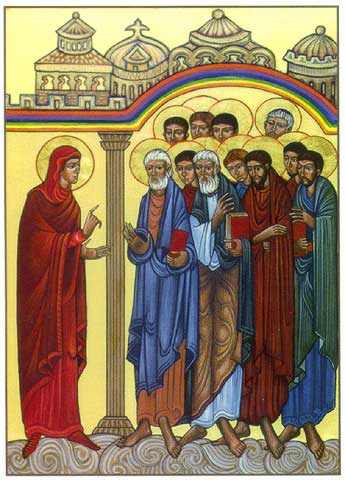
Mary Magdalene,
 apostle to the apostles.
But if I was a vicar, there'd be nothing too striking about a woman standing at the front and announcing that Christ is risen. Fortunately, in a lot of churches no-one would bat an eyelid that it was a woman speaking those words, and that's great - it shows us that those cultural expectations which Jesus began to challenge have continued to be challenged and changed to the extent where it's not so crazy to believe something a woman tells us. 

So if I was  vicar, how would I commemorate Mary Magdelene on Easter Sunday, how would I demonstrate that destruction of social hierarchy and the invitation for all to come and be part of announcing the good news? I think each Easter, I'd ask someone to take that role who is looked down on or disadvantaged by others in society for any kind of reason, because of class or race or sexual orientation or poverty or disability or age or anything else - we're so good at creating hierarchies and telling people they're not good enough, both inside and outside the church, that it shouldn't be a problem to think of many people who could well represent Mary and  take the honour given to her by Jesus. Maybe one year I'd ask the single teenage mum, maybe another year the long term alcoholic. Then the next year I'd ask the child of asylum seekers, and then the next year the great-grandmother with Alzheimers. Another year the trans* woman, and the next year the guy who just came out of prison. 

I'd be worried that to ask those people to make the Easter announcement might be insulting or patronising, as if trying to label them as people as the bottom of social hierarchies. But in reality, it's not about creating "us and them" groups but about recognising that none of the many reasons we look down on others and think ourselves above them makes any difference in this post-Easter community. It's about knowing how much we all need to hear the great news that Jesus is alive, and that we're all invited to be part of passing it on. It's about celebrating that news as a whole community, knowing that its not only for the privileged, the wealthy, educated, married, white, Western European men, but for the Mary Magdelenes too. It's for all of us. 

Sunday, 10 March 2013

When "Biblical" won't do.

Unpopular, yes.
Christian...? 
Christians are no strangers to being unpopular. Often we don't mind either, unpopularity is something to be expected, and even glad about. The gospel is counter-cultural, we say, it's always been "a stumbling-block to Jews and foolishness to Gentiles." So when it turns out that our society's values start to shift, and as Bible-believing Christians we're condemned as intolerant or homophobic (for instance), we shouldn't be surprised. We certainly shouldn't change the message, that would be bowing to cultural pressure rather than serving God.

Really?

Well, sort of... Those linked verses above do tell us to expect some persecution as Christians, some unpopularity, some opposition to the message. But that doesn't mean that all of it is a good thing and to our credit! Importantly, Jesus says "blessed are you when people...falsely say all kinds of evil against you because of me." That doesn't account for the times when those people might be right. It doesn't mean that everything that we say which is counter-cultural or offensive is necessarily good or true! In particular, just because something we say is at odds with contemporary British culture, it doesn't mean we're avoiding being affected by cultural values - it might just mean we're being influenced by different cultural values. 

Here's what I mean. My church had a guest service today, with a well-known evangelist preaching to a packed church. I like and respect him very much, and I know he has helped many people come to faith in Christ through his preaching and in his every day life, he's a really gifted man. But I was disappointed today that in his talk, I felt him to equate "believing the Bible" and "Biblical values" with what I'd consider to be a particular cultural expression of those values, a particular set of social or political values that rightly or wrongly often go hand in hand with conservative evangelicalism. As a Christian who doesn't share those same political views and doesn't believe that particular cultural expression of the gospel is completely appropriate in our culture, I felt alienated, so I wonder what those who had come as 'guests' to Church made of it all. If they were offended, or put off, I'm not sure it would be the gospel message (which was also faithfully preached) which made them wince but these trappings that came with it, the values which are presented as "the Biblical view" but which I'm not sure are very much to do with the gospel message at all. 

The particular example which featured in this mornings talk was marriage - the news that the Queen is expected to show support for gay rights was referred to as a saddening break away from the Biblical view of marriage. But it also extends to gender issues in general. I'm currently reading Rachel Held Evans' book, "A Year of Biblical Womanhood", which is a response to the 'Biblical manhood and womanhood' movement. She seeks to show that the idea that there is a single, 'Biblical' model of how to be a woman comes less from the Bible and more from the elevation of cultural ideals, like the 1950s housewife. She looks at various women in the Bible who by no means fit that model, which renders the idea of the Biblical woman as fairly empty. She also begins to put into practice some of the other suggestions, commands and models for Biblical women which are not mentioned by those who claim to hold to the Biblical view on gender - such as  the example of Sarah, who called her husband 'Master', not a practice continued by many now (I hope). 

Biblical marriage?
The same goes for marriage. The most common model of marriage in the Old Testament is for men to have multiple wives, as well as concubines and slaves with whom they have children (which has got to either challenge our view of marriage, or of sex outside of marriage!) This is the case for some of our Old Testament heroes, such as Abraham, Jacob, David and Solomon. There is provision made for this in the laws, such as in Exodus 21:10. Some would argue that the commands in the New Testament that church leaders should be "the husband of but one wife" suggest that polygamy was still practised by some in the Church, but was only prohibited for its leaders. 

I hope you won't misunderstand me: I'm not suggesting polygamy as a good model for marriage. I'm not saying we've picked the wrong 'Biblical' of marriage and we should switch to that one. I'm just trying to suggest that if we take the Bible seriously as a book written over a period of centuries, in many times and places, in a number of cultural contexts, it would be strange to expect it to produce a single model of gender roles, relationships, marriage, or a whole manner of other things actually. When we stop looking at the Bible as if it should offer us a single, coherent picture of these things and allow each part to speak in its own cultural context and for its own purposes, we see a lot more diversity than we thought. It probes us to consider our own values for gender and marriage and so on as our attempts to apply the values we find in the Bible, but not to hold them as the Biblical ideal. In the same way, when it comes to considering the questions of our society today - questions such as reproductive rights, or sex education, or same sex relationships, the idea that there is a clear, obvious, Biblical view on these questions just doesn't make sense to me. For all the many cultural contexts that the Biblical texts were written in, Britain in 2013 was not one of them. What we do when we try to think about how to answer these questions as Christians is to try our best to apply what we know about the character of God and the kingdom of God to a new situation - and we'll probably differ on the best way to do that. 

That's fine, and I'm all for more conversation, listening to each other and getting constructive dialogue going. I'm all for people coming to their tentative conclusions while being willing to listen to others who are equally trying seek God's will and consider their responses as Christians. What I'm not okay with is the use of the word "Biblical" to apply to a social or political view which simply didn't exist when the Bible was being written. I'm not okay with "Biblical" as a description of a cultural ideal of the nuclear family, complete with "stay-at-home Mom" and breadwinning, emotionally distant father as the only model for family life. Or Biblical as a perception of masculinity as active or dominant and femininity as passive and quiet. It's not helpful for our culture, it puts people off the gospel, but most importantly, I'm convinced it does a great injustice to the diverse, complex, sometimes difficult but often amazing men and women and their rich variety of experiences depicted in the Bible. It won't do to reduce them to an easy, cultural ideal, whether it's counter cultural here and now or not. 

Sometimes unpopularity isn't a cause for rejoicing at our suffering for the sake of the gospel. Sometimes it just means we're getting something wrong. 

Monday, 18 February 2013

Cracked heels and broken nails

I've got mixed feelings about my hands and feet. They don't look a lot like this for a start:


My feet - never much of a fan. I mean, I don't have a foot phobia like a couple of friends I could mention, but I've never found anyone's feet very attractive and I don't particularly rate my own. That's probably all the detail I'll go into on that.

My hands - feelings vary.  I quite like my hands for being little, except when it gets me mocked, and I like that a bit of skin is different colour, and that there's still a red dot there from the anaesthetic needle that went in when I was four. But really, how I feel about my hands depends a lot on the state of my nails. If you saw my last post, you'll have seen a picture of my nails when they were doing fairly well. When they're bitten and nasty, I'd rather keep my hands out of sight.


My feelings might change though if I thought of them as Christ's hands and feet.

The idea has been on my mind since our last Core Group meeting for the Church of England Youth Council, in which we were discussing how to incorporate social justice issues into a theme for the next full council meeting in April. The theme that we settled on was "Hands and Feet of Christ", and we wanted to make sure there was time in the day to unpick what that means for us and what it would look like.

As well as being obviously related to Paul's image of the Church as the body of Christ (presumably including hands and feet!), the image is taken from a poem by St Teresa of Avila, written in the 16th century:

Christ has no body but yours,
No hands, no feet on earth but yours,
Yours are the eyes with which he looks
Compassion on this world,
Yours are the feet with which he walks to do good,
Yours are the hands, with which he blesses all the world.
Yours are the hands, yours are the feet,
Yours are the eyes, you are his body.
Christ has no body now but yours,
No hands, no feet on earth but yours,
Yours are the eyes with which he looks
Compassion on this world.
Christ has no body now on earth but yours.


It's one thing to think in general, abstract terms that as the Church we're Christ's ambassadors in the world. I tend to think that means it's my job to look mildly offended on his behalf when someone uses his name irreverently. We're Christ's body, sure. That's a handy metaphor to remind us that we've all got different roles to play. For instance, for a normal Sunday morning, one person makes the Powerpoint of song words, another clicks through it during the songs, and another apologises afterwards for the wrong verses being shown at the wrong time. It's Christian team work. It's easy to think in those terms about being Christ's representatives or his body.

But Teresa's poem catapults the idea uncomfortably close to home. I can see my hands now. I can see my feet. These physical limbs, bits of body that I use constantly, all day every day, these are the pieces of bone and muscle and blood and stuff that Christ has chosen to use to do his work on earth. Fortunately, not only these ones; thank goodness for the rest of the Church. But all the same, he's chosen these ones.

So if Christ were to have exclusive use of my hands, what would he use them for? If he were living my life just as it is, what would he be doing with them? Would he be writing a blog post right now? Or would he be working in the local homeless shelter? Would he be holding the book I'm meant to be reading for tomorrow morning's class? Or would he be texting back the friend I haven't spoken to in so long?

What about my feet? Would he walk as quickly to lectures as I do, swerving in and out of the crowds on Cornmarket to avoid as many charity collectors as possible? Would he be walking towards people or away from people? To friends or strangers? Would he use my feet to be more committed to getting places on time and keeping commitments? Or would he use them to stop, to be interruptible whenever people need time? Would he walk alone around my college lake more often, to get space to really talk with his Father? Or would he invite another wherever he could so as not to waste an opportunity to love and encourage?

That's all just for now... Where on earth would he take them next year? Would he take these feet travelling around the world, using the hands to serve as many people as the feet took him to? Would he reaching out with human touch and comfort to forgotten children across the globe, taking them food and walking alongside them? Or would his steps be a little more contained within a parish, walking from house to house and stopping a while to really spend time with people? Perhaps he'd rather walk the same route each day to an office, using his hands to earn money, so he could give and serve with much more than before.

If you can see obvious answers to those questions, I'd love to hear your thoughts; if the answers are there, I'm missing them at the moment. What strikes me though is the sheer number of opportunities I have to use my hands and feet in the every day to show compassion and to bless. Which particular opportunity I pick at any one time seems to matter less than just picking something and doing it. Many aren't mutually exclusive, and perhaps if I were to start thinking just at one point in a day, "how might Jesus choose to use my hands and my feet in this particular situation, journey, opportunity?" then I might just find myself thinking that way more naturally. Perhaps I'd learn to live a life in which my hands and feet were constantly tools for Christ's work, when I was consciously thinking about it and when I wasn't.  In the mean time, I'll need to start asking that question more consciously. Where would you start? Does it matter what we choose to do with them in any one moment, or just that we do something through which Christ encourages and blesses and serves and loves?

My feet are really nothing special to look at (hence the lack of photo of my own...) and my hands don't look out of the ordinary either. But if I were to allow them to be used in each moment as very ordinary, physical, weak, vulnerable, human hands and feet of Christ, then they'd be something really remarkable. Perhaps then each broken nail, cracked heel and little toe rubbed raw and blistered wouldn't just be embarrassing imperfections on my limbs. They'd be signs that Jesus was getting good use out of them.

Friday, 14 December 2012

An open apology to inspiring women - and a very belated thank you.

My home church never had women preaching, and I grew up as a teenager believing that women shouldn't preach or lead churches. I understood there were difficulties with that view: at what age does a boy become a man whom I shouldn't teach? Did it apply to say, home groups, or only church services? What if I was sharing a testimony that had some explanation of the Bible in it? What about those women who feel called by God to lead and preach, can they all be mistaken? All the same though, I was convinced that was the right way to interpret the Bible. Men and women were made with different roles, and the challenge for was to work out how to maintain that they were equal while having such defined leader and follower roles.

This was all reinforced to me on the couple of occasions I’d heard women preaching. It seemed that they didn’t pay much attention to the Bible passage they were meant to be speaking from, and instead talked about their personal feelings and journeys, occasionally seemed close to tears and rarely preached the gospel. It all seemed a bit pathetic. Clearly God was right to leave preaching and Church leading to men, they could do it without crying and they knew that the gospel was more important than their own life story. Of course, I found excuses  for the one or two amazing women speakers I heard at events like Soul Survivor. They must have had special training, and the Church couldn’t afford to train everyone to that standard. They were only speaking to teenagers, and that was allowed.

Some things haven’t changed – I do still think men and women are different somehow. For all my musings and puzzling over gender, which I still don’t have many answers to, I think that I think that gender exists in some way which is not purely a social construct. I think “male and female he created them” does mean something, even though it doesn’t mean most of what we’ve taken it to mean. If you follow. Also, I do still think preaching from the Bible and explaining the gospel message clearly are hugely important. When I go to Church on a Sunday, the best thing for me to hear is a part of God’s word, explained and opened up, in a way that helps me hear God through it and think about how he might want to apply it to my life. 

Here’s what did change though – over a couple of years , in sixth form and on my gap year, I started to read for myself some books about those verses, the silencer verses. When dad went to theological college, the hypothetical women who felt called to lead were no longer hypothetical, they were my dad’s friends. One of them (to whom is owed a greatly overdue thanks) gave me a book and lent me another, which started to open my eyes to the possibility that there were people who took the Bible as seriously as, if not far more seriously than, me and yet still believed women could and should be leaders in today’s church. As I started to read about contexts, about language, about big theological concepts and good methods of interpretation and exegesis, my mind was blown. I wasn’t instantly convinced, and I read enough conservative material to keep me on the fence for a while, but by the time January 2010 came around, I was ready to try preaching out myself. Once I stopped reading the entire Bible in the light of one interpretation of a couple of verses (never a good way round to work out what the Bible means!) I discovered that equal really does mean equal to God, without ifs, buts or qualification. It set me free to see what God really thinks of women. 

Ever since I started that first bit of reading in sixth form and allowed myself to see how God can and does use women in amazing ways, I’ve been inspired by so many amazing women, especially in the last few months. So I want to say a huge thank you: to the women I know and those I don’t know, those whose sermons I’ve learned so much from, those whose blogs I read and books I’ve started, to those I get to have breakfast dates and coffee dates with, those who minister to me and teach me every day, those who listen to me think aloud and are patient when I need to work out the same thoughts all over again – thank you, and I’m so sorry I doubted you.

I’ve learned that being a man in no way guarantees you'll be good at teaching the Bible - I've heard as many vague, 'here are my thoughts with little connection to the passage' sermons from men as from women. But far more importantly, I've learned that women absolutely can teach the Bible and explain the gospel, and I’m sorry I ever thought I needed to ‘preach like a man’ if I were to be any good. People like Danielle Strickland, Ali Martin, Becky Manley Pippert and MJ Axelson have left me in no doubt about that. I'm so grateful to role models closer to home who've modelled to me various kinds of teaching and pastoral ministry like Michelle Tepper, Laura Gallacher and Sharon Mac. 

I’ve learned that women’s experiences, their feelings, and their journeys are in no way pathetic but incredibly valuable, that vulnerability isn’t weakness but strength, and it strengthens everyone who has the honour of sharing it. I’ve learnt that it’s not just about women needing to cry all the time, but that men and women all need to share themselves in community, to journey together – and that those words aren’t touchy feely rubbish but a hugely important part of what it means to be gospel-believing followers of Jesus. To see this lived out has validated my own experiences, feelings and journey, and reassured me I'm not pathetic too. 

I’ve learnt that being a woman doesn’t mean being judgemental or closed or bitchy, but it can mean sharing life together in a way I’d never really done before. Friends who’ve stuck around, who’ve dealt with my crap, who’ve shared theirs with me, who’ve talked honestly, who’ve reassured me, who’ve prayed for me, who’d questioned with me, have become the most inspiring people in my life.

I’ve learnt that I want to be like my mum when I grow up. The more of myself I’ve shared honestly with her in the last couple of years, the more she’s taught me about strength, compassion, resilience and grace. I want to share her determination and her humility and her sense of humour, if not her wardrobe. My little sister (who is not little any more but a beautiful and opinionated woman) constantly inspires me too with her stories of how she challenges the misconceptions and ignorance she sometimes hears at school and questions whatever she hears, so as to know her own mind. She even manages to do it without losing friends, which I think is admirable in itself! I hope she keeps challenging me like that for years to come.

I’ve learnt that women really can be funny – since mum bought me “How to be a woman”, and my college mum (if I remember rightly, Rosie?!) sat me down to watch Miranda, I’ve discovered that the experiences and ups and downs that many women seem to share are put into this hilarious kind of perspective when reflected back to you by someone like Caitlin Moran or Miranda Hart. And it makes life that little bit better.

I’ve learnt that women who stand up against misogyny in all its forms are not pointlessly angry, making a fuss over nothing, bra burning man haters. I’ve learnt that feminism is necessary and good, despite the few who give it a bad name. I’ve learnt that it’s definitely not all men who cat-call and grope, objectify and dehumanise women  - but that the ones who do need to be challenged, and there are plenty of women and men doing just that. The Everyday Sexism Project, the Misogyny Overheard at Oxford group, and the No More Page 3 Campaign have all inspired me to join in.

I could go on. There are so many blogs and stories and books I want to keep reading, so many women I want to meet and pick the brains of and listen to and learn from. But even to those I won’t get around to reading the thoughts of or won’t get to meet and have a conversation with, I still owe my thanks. Just knowing that they’re all over the place, getting on with life with grace and compassion and strength and humour is pretty inspiring, and it makes me want to do the same. It’s because of everyone of these people and groups I’ve mentioned that I feel free now to explore my own call to ministry, whatever that might look like, and free to do it as I am, as a woman, whatever difference that might make. So thank you too for that.

I can’t say for sure that there is a causal link between my change of theological position on women in leadership and speaking roles in the church, and my learning so much from these inspiring women. But while I held the difference between men and women to be the most important thing, and struggled to fit some idea of a kind of equality around that, I don’t think I’d ever have listened as closely or been so open to what God could teach me through the words of women.

Final apology – if you see me sending this post to a lot of people on Twitter or Facebook, please excuse the repetition. It’s only that I want to make sure the apology and the thank you reaches those it’s most intended for.

Love, Claire xxx

Sunday, 25 November 2012

One Body - CEYC poem

[I spent this weekend at the Church of England Youth Council meeting, which was great - I'll probably have something more to write about it later. As part of the worship for this morning, I wrote this poem - it's based on 1 Corinthians 12:12-26, and I hope it reflects something of the strong desire that the whole council felt for unity despite, and perhaps because of, diversity.]

We are many people, we are many parts,
But we are one body, with one beating heart.
We have different passions, each with our own gifts,
But our unity runs deeper than superficial rifts.
Baptised in to Christ, whoever we are,
His love has drawn close strangers who were far.
Not one unimportant, not one valued less,
So the strong work together, the weaker to bless.
God's brought us together, not left on our own.
When one part is hurting, it can't suffer alone.
But the body is to comfort and commit to each other,
Bearing the burdens of our sisters and brothers.
As our voices join and one song we sing,
We proclaim to the world that Jesus is king.

Wednesday, 21 November 2012

Gut reaction

[My gut reaction to the vote against the women bishops motion at General Synod last night. I might have something more intelligible to say at some point...]

Tired, God.
Eyes, red raw.
Head fuzzy.
Too many questions.

How could you let this and what do you want and when will it ever and is it even right?
And why so divided and what is the answer and why does your Church have to cause pain and fight?

Exhausted, Father.
Pounding drum inside.
Doubts bubble.
Is it worth it?

Why so many churches and is there just one and how do you speak and do we know how to hear?
And do we trust our leaders and and do we know we're right and when it's all hopeless, God will you be near?

Feel small, Lord.
Nothing smart to say.
They talk so loud.
I'm just one.

You've made us a body and we are connected, do we love one another and do we feel each other's pain?
And can we still commit and will we live out humble service and will you strengthen your Church to come together again?

Commitment.
You challenge and call us.
Deny self, follow you.
Any cost, any pain.
Restless hearts need peace.
Need you.
Help please.

Sunday, 18 November 2012

Feet in high heeled shoes


As a kid my parents told me “you can be whatever you choose,”
So I dreamt of being a singer and learning to walk in high heeled shoes.
And I started a fashion company, and I designed football kits for dogs
(Yeah, really I did, it combined all of my passions in one ideal job).
Then I looked around me and saw a planet that needed saving,
So in my infants school, I "saved the daisies" by making everyone walk on the paving.
I gave assemblies on human trafficking because I thought my school needed to be told
That even in this day and age, there are people being bought and sold.
I wanted to change the world, and more than anything I still do,
But as I grew up I realised that I didn’t just love the sound of my own voice,
I love God’s people too.
As I met a God who knows me and loves me and stuck with me through a whole load of mess,
I could see no better reason to live than to give myself to bless
The broken and the hurting and those who don’t know him still,
And to encourage those who do, as together we seek his will,
And as we build each other up and as we gather round his word,
I want to sing the loudest, to make sure his praises will be heard.
I want to be part of it, at the heart of it, and though its a massive learning curve,
If God will use me despite my weakness, it’s his church I want to serve.

So as a woman I’m frustrated that it's still now being debated
As to whether my field of service will stay ring fenced and gated.
See, I’m not trying to argue that Jesus had a modern feminist agenda,
But that he radically liberated women from societal expectations of our gender.
I get that those who oppose it are trying to stay true to God’s word
But if you’re questioning my motives, above all let this be heard:
"Whoever wants to be an overseer, he desires a noble task"
So why is it career-driven, selfish ambition when its she who dares to ask?
No, I love the Bible too, and everything it’s got to say,
I don’t want to ignore Paul, or just to run the church my way,
But when I’ve looked at the cultural context of what Paul said on women leading
I think his prohibitions were context specific, and that's my most sincere reading.
Today I think he’d want to see all hands set to the gospel’s task
Served by an army of faithful bishops whose gender no one thinks to ask.
So let’s get on with being Christ’s body, in trainers, deck shoes or high heels,
Let’s be the feet who take good news to a world he longs to heal.
And when it comes to where and how I’ll serve, it’ll be God who gets to choose
But I long to do it in a church where women bishops are old news.